
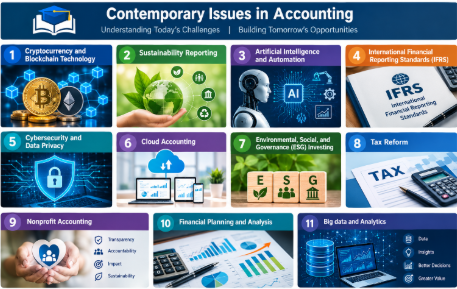
Module description and its aim
Contemporary Issues in Accounting is designed to provide students with an understanding of current, emerging, and evolving issues affecting accounting theory, practice, regulation, and the accounting profession. The module examines how technological, economic, regulatory, environmental, social, and ethical developments are changing the role of accountants and the preparation, reporting, analysis, and use of accounting information. It enables students to critically examine contemporary challenges and developments in accounting and their implications for organizations and stakeholders.
The aim of this module is to equip students with knowledge and analytical skills to critically examine contemporary developments and challenges in accounting and evaluate their implications for accounting practice, financial reporting, decision-making, organizations, and the accounting profession.
Learning Outcomes
By the end of this module, students should be able to:
- Explain the major contemporary issues and developments affecting accounting theory and practice.
- Analyse the impact of technological developments such as artificial intelligence, cloud computing, big data, and blockchain on accounting.
- Evaluate emerging developments in financial reporting and international accounting standards.
- Assess the role of accounting in sustainability, environmental responsibility, and ESG reporting.
- Examine ethical, professional, corporate governance, and accountability issues affecting accountants and organizations.
- Analyse contemporary challenges in auditing, taxation, management accounting, and public sector accounting.
- Apply appropriate accounting concepts and professional principles to contemporary accounting problems and case studies.
- Critically evaluate the opportunities and challenges created by emerging developments for the future of the accounting profession.
- Recommend appropriate responses to contemporary accounting challenges based on professional, ethical, regulatory, and organizational considerations.
- Teacher: AUGUSTIN MUDAKEMWA